
Is BMI an Accurate Metric for Analysing Health? An Indian Perspective


It is a sentence that thousands of Indians hear every year during routine health check-ups. For many, it brings relief. A normal BMI often feels like a clean bill of health.
But is it really?
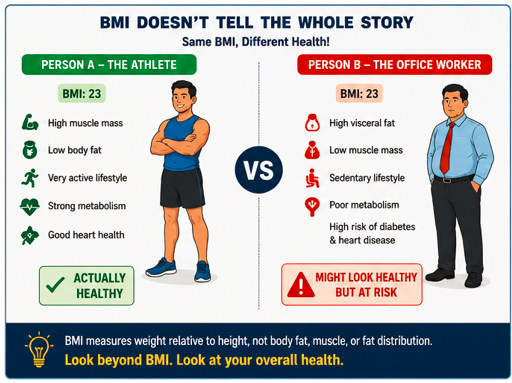
Imagine two people standing next to each other. Both have the same BMI of 23. One is a marathon runner with strong muscles and very little body fat. The other spends most of the day sitting, has excess fat around the abdomen, and has early signs of diabetes.
According to the BMI chart, both are equally healthy.
Clearly, something doesn't add up.
This is one of the biggest limitations of Body Mass Index (BMI). It measures only your weight relative to your height. It does not measure body fat, muscle mass, bone density, or where fat is stored in your body.
For Indians, this limitation is even more important. Research has consistently shown that Indians develop diabetes, heart disease, and other diet-related diseases at lower BMI values than many Western populations. In other words, you can have a "normal" BMI and still carry unhealthy levels of body fat.
So, should we stop using BMI altogether? Or should we simply understand what it can—and cannot—tell us?
Let's begin by understanding where BMI came from and why it became the world's most popular health measurement.
What Exactly Is BMI?
Body Mass Index is a simple mathematical formula:
BMI = Weight (kg) ÷ Height² (m²)
For example:
Weight = 70 kg
Height = 1.70 m
BMI = 70 ÷ (1.70 × 1.70) = 24.2
According to the World Health Organization (WHO), this falls within the "normal" weight category for many populations.
Because it only requires height and weight, BMI is quick, inexpensive, and easy to calculate. That simplicity explains why hospitals, insurance companies, gyms, schools, and health surveys continue to use it around the world.
But simplicity often comes with compromises.
A Belgian Statistician Never Intended BMI to Measure Individual Health
Here's an interesting fact that surprises many people.
BMI was never designed to assess an individual's health.
It was developed nearly 200 years ago by Adolphe Quetelet, a Belgian mathematician, astronomer, and statistician. Interestingly, Quetelet wasn't a doctor. He was fascinated by mathematics and wanted to understand how physical characteristics varied across large populations.
Around the 1830s, he developed what he called the Quetelet Index, which later became known as Body Mass Index.
His goal was not to diagnose obesity.
Instead, he wanted to describe the "average man" using statistical methods.
For more than a century, the Quetelet Index remained largely an academic concept.
Everything changed in the 1970s.
How BMI Became the World's Favourite Health Number
In 1972, American physiologist Ancel Keys evaluated several methods used to estimate obesity.
After comparing different formulas, he concluded that BMI was the simplest practical tool for studying large populations.
That recommendation transformed BMI from a statistical calculation into a global public health standard.
Today, it is used by:
Governments
Hospitals
Health insurance providers
Fitness centres
Medical researchers
Its greatest strength is also its greatest weakness.
It is incredibly easy to calculate.
But the human body is far more complex than one mathematical equation.
Why Doctors Still Use BMI
Despite its flaws, BMI remains useful.
Imagine screening thousands of people during a national health survey.
Measuring body fat accurately for every person would require expensive scanners, trained technicians, and enormous amounts of time.
BMI solves that problem.
With just height and weight, healthcare professionals can quickly identify populations at higher risk of obesity and related diseases.
For public health planning, BMI works reasonably well.
For individual health decisions, however, it often tells only part of the story.
The Biggest Limitation of BMI
BMI measures how heavy you are.
It does not measure what your body is made of.
Your total body weight consists of many components:
Muscle
Fat
Bones
Water
Organs
BMI treats all of them exactly the same.
This creates several problems.
Example 1: The Athlete
A professional weightlifter may have a BMI that classifies them as overweight.
But most of that extra weight comes from muscle—not fat.
According to BMI, they appear unhealthy.
In reality, they may be exceptionally fit.
Example 2: The Office Worker
Now consider someone who rarely exercises.
Their BMI falls within the "normal" range.
However, they carry excess fat around the abdomen, have low muscle mass, and elevated blood sugar.
BMI labels them healthy.
Their metabolism tells a different story.
Why Fat Location Matters More Than Weight
Not all body fat behaves the same way.
Fat stored just beneath the skin is called subcutaneous fat.
Fat stored deep inside the abdomen around organs like the liver, pancreas, and intestines is called visceral fat.
Visceral fat is far more dangerous.
It releases inflammatory chemicals into the bloodstream and increases the risk of:
Heart disease
High blood pressure
Fatty liver disease
BMI cannot distinguish between these two types of fat.
Someone with dangerous visceral fat may still have a perfectly "normal" BMI.
An Interesting Observation from Traditional Indian Diets
For generations, many South Indian families relied on simple meals built around whole foods rather than heavily processed products.
Breakfast often included:
Steamed rice or roti
Idli with sambar
Fermented dosa
Fresh coconut chutney and veggies
Lunch featured vegetables, pulses, curd, and rice that was often less processed than today's polished varieties.
These meals naturally provided fibre, protein, and micronutrients.
Today, however, many diets have shifted towards ultra-processed foods, sugary beverages, refined flour products, and packaged snacks.
This change in lifestyle has contributed to rising obesity, diabetes, and other diet-related diseases.
Today, the picture is very different.
Many of us spend:
8–10 hours sitting
commuting by car
working on computers
eating ultra-processed snacks
drinking sugary beverages
This modern lifestyle has dramatically reduced daily movement while increasing calorie intake.
As a result, body composition has changed—even among people whose BMI remains "normal."
🌾 Returning to Traditional Foods
Nutrition experts increasingly recommend moving back towards whole foods rather than ultra-processed products.
Traditional Indian diets naturally included:
vegetables
lentils
seasonal fruits
fermented foods
Unlike refined grains, unpolished millets retain their bran layer, providing:
fibre
magnesium
antioxidants
B vitamins
Similarly, unpolished rices contain significantly more fibre and micronutrients than polished white rice.
Many health-conscious families searching for healthy foods are now rediscovering these traditional staples. The increasing popularity of millets in Bangalore and other metropolitan cities reflects this growing awareness.
These foods not only nourish the body but also support long-term metabolic health.
Many nutrition experts now encourage a return to healthy foods, including natural food, unpolished millets, and unpolished rices, alongside plenty of vegetables, pulses, nuts, and seasonal fruits.
Why BMI Is Less Accurate for Indians
One of the biggest discoveries in metabolic research over the past two decades is that Indians store fat differently from many Western populations.
Several studies have shown that Indians tend to:
Carry more body fat at the same BMI
Develop visceral fat earlier
Have less skeletal muscle
Become insulin resistant at lower body weights
Develop diabetes and heart disease at younger ages
This means that two people with exactly the same BMI may have very different metabolic health depending on their ethnicity.
An Indian man with a BMI of 23 may carry significantly more abdominal fat than a European man with the same BMI.
This hidden fat increases the risk of chronic diseases long before the BMI enters the "overweight" category.
🧬 The "Thin Outside, Fat Inside" (TOFI) Phenomenon
One of the most fascinating concepts in modern medicine is called TOFI — Thin Outside, Fat Inside.
At first glance, these individuals look healthy.
They wear medium-sized clothes.
Their BMI appears normal.
Friends often describe them as "lean."
Yet, inside the body, the picture is very different.
Fat begins accumulating around vital organs such as:
the liver
the pancreas
the intestines
the heart
This type of fat is called visceral fat, and it behaves very differently from fat under the skin.
Unlike visible body fat, visceral fat is biologically active. It releases inflammatory chemicals that interfere with insulin, damage blood vessels, and increase the risk of several diet-related diseases. Many Indians unknowingly fall into this category. 📊 The "Asian Indian Phenotype"
Medical researchers now describe a characteristic known as the Asian Indian Phenotype.
This refers to the tendency of many Indians to develop metabolic diseases despite appearing relatively slim.
Common features include:
✔ Higher body fat percentage
✔ Lower muscle mass
✔ Larger waist circumference
✔ Higher insulin resistance
✔ Earlier onset of diabetes
✔ Higher triglycerides
This explains why many doctors no longer rely solely on BMI when evaluating Indian patients.
⚖ BMI vs Body Fat Percentage
This is where things become interesting.
BMI measures:
Total body weight
Body Fat Percentage measures:
How much of your body is actually fat
Two individuals may both weigh 70 kg.
Their BMI is identical.
Yet their body fat percentages can be completely different.
Example
Person A
BMI: 23
Body Fat: 15%
Excellent muscle mass
Healthy metabolism
Person B
BMI: 23
Body Fat: 33%
Low muscle mass
High visceral fat
Prediabetes
BMI says both are equally healthy.
Body composition says otherwise.
💪 Why Muscle Matters
Muscle is often underestimated.
It isn't just important for athletes.
Muscle acts like a metabolic engine.
Healthy muscle:
burns glucose
improves insulin sensitivity
supports mobility
protects bones
increases calorie expenditure
Unfortunately, many Indians lose muscle as they age because of:
low protein intake
sedentary work
inadequate strength training
As muscle decreases, body fat often increases—even if body weight remains stable.
BMI completely misses this change.
📉 The "Normal BMI" Trap
One of the biggest dangers of BMI is the false reassurance it can provide.
Many people think:
"My BMI is normal, so I don't need to worry."
But health isn't determined by one number.
Someone with a BMI of 22 may already have:
fatty liver
insulin resistance
elevated cholesterol
increased waist circumference
poor cardiovascular fitness
Conversely, another individual with a BMI of 27 may have excellent fitness and normal metabolic markers because they possess greater muscle mass.
This is why doctors increasingly look beyond BMI.
🧠 Interesting Facts About BMI
✔ Fact 1
BMI does not distinguish between fat and muscle.
✔ Fact 2
Professional athletes are often classified as overweight according to BMI despite having very low body fat.
✔ Fact 3
More than half of South Asians with Type 2 diabetes are not considered obese by international BMI standards.
✔ Fact 4
Waist circumference often predicts heart disease better than BMI.
✔ Fact 5
The World Health Organization recognises that Asian populations develop health risks at lower BMI values than many Western populations.
🌱 Health Is More Than Weight
Modern nutrition is moving away from focusing only on body weight.
Instead, experts encourage looking at the complete picture.
Healthy living means:
eating natural food
choosing whole foods
including vegetables every day
consuming unpolished millets
preferring unpolished rices
staying physically active
sleeping well
These habits contribute far more to long-term health than chasing a perfect BMI number.
If our goal is an obesity free India, we need to encourage better nutrition, regular physical activity, and awareness—not just lower numbers on a weighing scale. If BMI doesn't tell the whole story, what should we measure instead?
The answer is encouraging. You don't need expensive medical equipment to gain a much clearer picture of your health. In fact, some of the most useful indicators are simple, affordable, and can be measured at home.
Let's explore the tools that matter more than BMI—especially for Indians.

📏 1. Waist Circumference – A Better Indicator of Health
Imagine two people with the same BMI of 24.
One has most of their weight around their hips and legs.
The other carries fat around the waist.
Who is at greater risk?
Research consistently shows that the second person is more likely to develop diabetes, heart disease, fatty liver disease, and high blood pressure.
That's because abdominal fat, particularly visceral fat, surrounds vital organs and interferes with normal metabolism.
This is why doctors increasingly pay attention to waist circumference.
Recommended Waist Circumference for Indians
According to Indian and international health guidelines:
Men: Less than 90 cm (35.4 inches)
Women: Less than 80 cm (31.5 inches)
Values above these limits indicate a higher risk of metabolic diseases—even if BMI is considered "normal."
How to Measure Your Waist Correctly
It's simple:
Stand upright and relax.
Place a measuring tape around your abdomen, midway between your lowest rib and the top of your hip bone.
Breathe out gently.
Record the measurement without pulling the tape too tightly.
This one measurement often provides more useful information than BMI alone.
📐 2. Waist-to-Height Ratio – A Simple Rule Everyone Can Remember
Many experts now consider the Waist-to-Height Ratio (WHtR) one of the best indicators of future health risk.
The formula is straightforward:
Waist Circumference ÷ Height
But you don't even need to calculate it.
Just remember one simple rule:
Keep your waist less than half your height.
For example:
Height: 170 cm
Half of height: 85 cm
A waist measurement below 85 cm generally indicates lower metabolic risk.
Unlike BMI, this method considers body proportions rather than just weight.
Several studies have shown that waist-to-height ratio predicts cardiovascular disease and diabetes more accurately than BMI in many populations, including Asians.
🧬 3. Body Fat Percentage – Understanding What Your Weight Is Made Of
Your bathroom scale tells you only one thing:
How much you weigh.
It doesn't tell you what makes up that weight.
Body fat percentage separates your body into two broad components:
Fat Mass
Lean Mass (muscles, bones, organs, and water)
This distinction matters.
Two people can weigh exactly the same but have completely different health profiles.
Healthy Body Fat Percentage (General Guidelines)
Men
Essential fat: 2–5%
Healthy range: Approximately 10–20%
Women
Essential fat: 10–13%
Healthy range: Approximately 18–28%
(Healthy ranges vary slightly by age and organisation.)
A person with a normal BMI but high body fat may already be at increased risk of insulin resistance and metabolic syndrome.
💪 4. Muscle Mass – The Hidden Hero of Good Health
When people think about fitness, they often focus on losing fat.
But building and maintaining muscle is equally important.
Muscles are not just for strength.
They play a crucial role in:
regulating blood sugar
improving insulin sensitivity
supporting metabolism
protecting joints
maintaining balance as we age
Unfortunately, many Indians consume less protein than recommended while spending long hours sitting.
Over time, this leads to a gradual loss of muscle—a condition known as sarcopenia, especially in older adults.
As muscle decreases, body fat often increases.BMI rarely reflects this change.
🔬 How Can You Measure Body Composition?
Fortunately, modern technology offers several options.
1. Bioelectrical Impedance Analysis (BIA)
Many gyms and health clinics now use BIA machines.
They estimate:
body fat
muscle mass
water percentage
visceral fat score
While not perfect, they provide far more information than BMI alone.
2. DEXA Scan
A Dual-Energy X-ray Absorptiometry (DEXA) scan is considered one of the most accurate methods for measuring body composition.
It provides detailed information about:
body fat distribution
muscle mass
bone density
Although more expensive, it is extremely useful for people with complex health concerns.
3. Skinfold Measurements
Performed by trained professionals, skinfold calipers estimate body fat by measuring fat beneath the skin.
While less sophisticated than DEXA, they are useful when done correctly.
🩺 5. Blood Tests Tell a Bigger Story Than BMI
Good health isn't visible from the outside.
A person may appear slim yet have abnormal blood test results.
Regular health screening should include:
Fasting Blood Sugar
HbA1c
Lipid Profile
Liver Function Tests
Blood Pressure
These indicators often reveal metabolic problems long before BMI changes.
For Indians with a family history of diabetes or heart disease, these tests are especially important.
📊 A Better Health Checklist Than BMI
Instead of asking only:
"What's my BMI?"
Try asking these questions:
✅ Is my waist circumference within the healthy range?
✅ Is my waist less than half my height?
✅ Am I maintaining healthy muscle mass?
✅ Do I exercise regularly?
✅ Are my blood sugar and cholesterol under control?
✅ Do I eat mostly whole foods rather than ultra-processed foods?
These questions paint a far more accurate picture of health than BMI alone.
Health Is Built in the Kitchen, Not on the BMI Chart
The saying "You are what you eat" is more relevant today than ever before.
Many people focus on calories alone. But our bodies don't simply count calories—they respond to the quality of the food we consume.
Imagine two lunches, each providing about 600 calories.
Meal A
White rice
Potato chips
Sweetened soft drink
Meal B
Unpolished rice
Vegetable sambar
Greens poriyal
Sprouted green gram salad
Curd
The calorie count may be similar, but the nutritional value is worlds apart.
The second meal provides:
Fibre
Protein
Vitamins
Minerals
Healthy fats
Beneficial gut bacteria
These are the nutrients that help prevent diet-related diseases and support long-term metabolic health.
🌾 Rediscovering Traditional Indian Grains
One of the biggest dietary changes in India over the past few decades has been the shift from traditional grains to highly refined cereals.
Earlier generations regularly consumed:
Foxtail millet
Little millet
Barnyard millet
Kodo millet
Pearl millet
Hand-pounded rice
Red rice
These foods were naturally rich in fibre and micronutrients.
Today, many households rely heavily on polished white rice, refined wheat flour, and packaged breakfast cereals.
Fortunately, awareness is growing.
The increasing popularity of millets in Bangalore, Chennai, Hyderabad, and several other cities shows that many families are returning to traditional eating habits.
Unpolished millets and unpolished rices are excellent examples of whole foods that support better digestion, improve satiety, and provide a steady release of energy.
Even the healthiest diet cannot completely compensate for a sedentary lifestyle.
Physical activity improves:
Insulin sensitivity
Muscle strength
Bone density
Mental well-being
Current recommendations suggest:
Aerobic Activity
At least 150 minutes of moderate-intensity exercise each week.
Examples:
Brisk walking
Cycling
Swimming
Strength Training
At least 2 sessions per week.
This is particularly important because muscle mass naturally declines with age.
Remember, BMI does not tell us whether we have enough muscle. Strength training helps preserve this valuable tissue and supports healthy metabolism.
😴 Sleep and Stress: The Forgotten Health Markers
Many people underestimate the importance of sleep.
Poor sleep can:
Increase hunger hormones
Raise blood sugar
Promote weight gain
Increase inflammation
Likewise, chronic stress elevates cortisol levels, encouraging fat storage around the abdomen.
No BMI calculation can capture these effects.
Simple habits such as maintaining regular sleep timings, practising meditation, spending time outdoors, and limiting screen exposure before bedtime can significantly improve overall health.
⚖️ Don't Chase a Number—Build Healthy Habits
One of the biggest mistakes people make is focusing only on the weighing scale.
Weight naturally fluctuates due to:
Water balance
Muscle gain
Hormonal changes
Meal timing
Instead of asking:
"How many kilograms did I lose?"
Ask:
Am I stronger?
Am I sleeping better?
Has my waist reduced?
Is my blood sugar improving?
Do I feel more energetic?
These are far more meaningful indicators of progress.
🌍 Building an Obesity-Free India Starts at Home
India is facing a unique health challenge.
We are seeing rising rates of:
Type 2 diabetes
Fatty liver disease
Hypertension
Many of these conditions are strongly influenced by diet and lifestyle.
📋 Practical Checklist for Better Health
Instead of relying only on BMI, try following this simple checklist:
✅ Measure your waist circumference every month.
✅ Aim for your waist to be less than half your height.
✅ Include vegetables in every meal.
✅ Eat protein with each meal.
✅ Replace refined grains with unpolished millets or unpolished rices several times a week.
✅ Limit sugary drinks and packaged snacks.
✅ Walk after meals whenever possible.
✅ Strength train twice a week.
✅ Sleep 7–8 hours every night.
✅ Get annual blood tests if you have a family history of diabetes or heart disease.
💡 Interesting Facts
🌾 Fact 1
Millets were staple foods in many parts of India long before polished white rice became widely available.
🩺 Fact 2
Many Indians develop diabetes nearly 10 years earlier than Western populations.
💪 Fact 3
Increasing muscle mass can improve insulin sensitivity even without major weight loss.
❤️ Fact 4
Reducing waist circumference often lowers health risks even when BMI changes very little.
🌱 Fact 5
A diet built around whole foods is associated with lower inflammation and improved long-term health.
❓ Frequently Asked Questions
1. Should I stop using BMI completely?
No. BMI is still a useful screening tool. However, it should be interpreted together with waist circumference, body composition, blood tests, and overall lifestyle.
2. Why are Indians more prone to diabetes even with a normal BMI?
Many Indians carry higher levels of visceral fat and have lower muscle mass despite appearing lean. This increases insulin resistance and metabolic risk.
3. Is waist circumference more important than BMI?
For many Indians, yes. Waist circumference provides valuable information about abdominal fat, which is strongly linked to metabolic disease.
4. Which foods should I include for better metabolic health?
Focus on healthy foods such as vegetables, pulses, nuts, seeds, fermented foods, fruits, unpolished millets, and unpolished rices. These are excellent whole foods that support steady energy and overall well-being.
5. Can I reduce visceral fat without losing a lot of weight?
Yes. Regular exercise, improved sleep, stress management, and eating minimally processed natural food can reduce visceral fat even if body weight changes only slightly.
6. How often should I check my health?
Adults should undergo regular health screenings, including blood sugar, cholesterol, blood pressure, and waist circumference measurements. Individuals with a family history of diabetes or heart disease should consult their healthcare provider about the appropriate frequency.
📚 Scientific References
World Health Organization (WHO). Obesity: Preventing and Managing the Global Epidemic. WHO Technical Report Series 894.
WHO Expert Consultation. Appropriate Body-Mass Index for Asian Populations and Its Implications for Policy and Intervention Strategies. The Lancet. 2004;363:157–163.
Indian Council of Medical Research (ICMR) & National Institute of Nutrition (NIN). Dietary Guidelines for Indians. 2024.
Misra A, Vikram NK. Insulin Resistance Syndrome (Metabolic Syndrome) and Obesity in Asian Indians. Current Science.
American Diabetes Association. Standards of Care in Diabetes. Updated annually.
International Diabetes Federation (IDF). The IDF Consensus Worldwide Definition of the Metabolic Syndrome.
🌟 Final Thoughts
BMI has served medicine well for over a century. It is simple, quick, and useful for assessing health trends across large populations. But when it comes to understanding your health, it is only one piece of a much larger puzzle.
For Indians, looking beyond BMI is particularly important. Waist circumference, body composition, physical activity, sleep quality, and dietary habits often provide a more accurate picture of metabolic health than weight alone.
The path to better health does not begin with chasing a lower BMI. It begins with everyday choices—choosing healthy foods, embracing natural food, filling your plate with whole foods, and bringing back traditional staples like unpolished millets and unpolished rices. Combined with regular movement and mindful living, these habits can reduce the burden of diet-related diseases, support healthy weight loss when needed, and help build an obesity free India.
At the end of the day, the most meaningful measure of health is not simply how much you weigh, but how well your body functions, how energetic you feel, and how sustainably you can maintain a healthy lifestyle for years to come.


Comments