
Is Salt Really the Main Cause of High Blood Pressure? An Indian Perspective

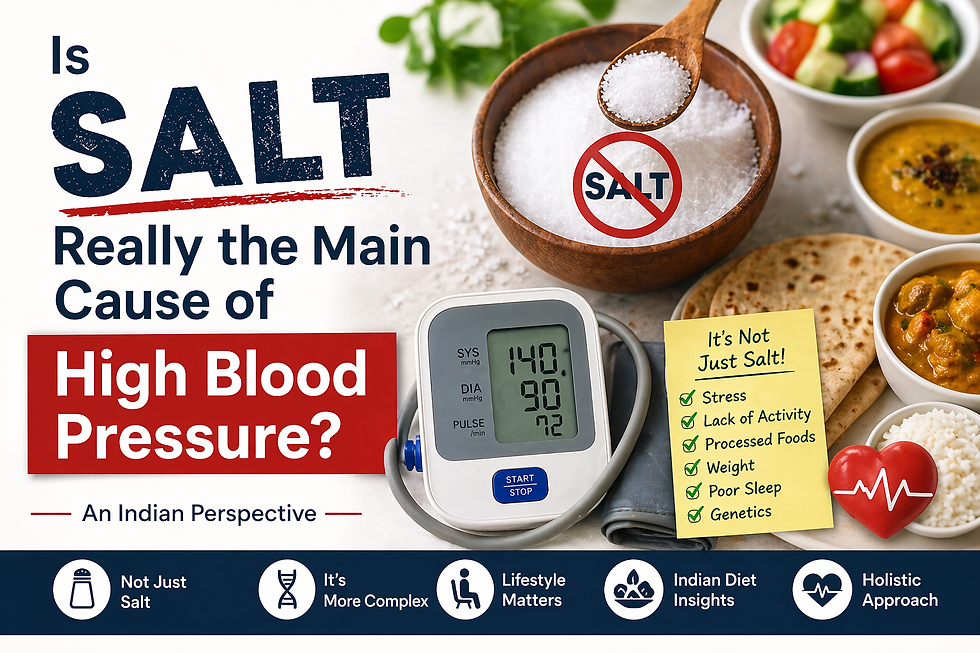
High blood pressure—or hypertension—is often called a “silent killer.” In India, it’s rising rapidly across both urban and rural populations. The moment someone is diagnosed, the advice is almost automatic: “Reduce salt.”
It sounds simple. It feels actionable. And yes, salt does play a role. But here’s the truth—focusing only on salt is an incomplete and sometimes misleading approach.
In this blog, we’ll break down the real relationship between salt and blood pressure, and more importantly, explore the often-overlooked dietary and lifestyle factors that matter just as much—if not more—for long-term heart health.
🧠 Understanding How Salt Affects Blood Pressure
Salt contains sodium, and sodium has a well-known effect on the body: it pulls water into the bloodstream, increasing blood volume. More volume means more pressure on artery walls—hence, higher blood pressure.
But here’s the part that’s often missed.
👉 In a healthy body, your kidneys are incredibly efficient.They detect this increase and quickly remove excess sodium and water through urine, bringing blood pressure back to normal.
So why do some people still have high blood pressure even after cutting down salt?
👉 Because the issue is often not how much salt you consume, but how your body processes it.
⚖️ Why Salt Isn’t the Whole Story
Not everyone responds to salt the same way. This concept is called salt sensitivity.
Some people are highly sensitive → BP rises easily
Others are resistant → little to no effect
This explains why:
One person eats pickles and papad daily but has normal BP
Another reduces salt but still struggles
👉 The real issue lies deeper—in metabolism, nutrient balance, and overall diet quality.
🥬 The Bigger Picture: What Really Drives High Blood Pressure
Let’s explore the key factors that often get ignored in Indian diets.
1. Magnesium Deficiency: The Hidden Problem
Magnesium is essential for relaxing blood vessels. Without it, arteries stay slightly constricted, increasing pressure.
Why Indians are at risk:
High consumption of refined foods (maida, white rice)
Low intake of unpolished grains and millets
Increased sugar intake → magnesium loss
What helps:
Leafy greens (spinach, amaranth)
Nuts and seeds, pumpkin seeds have lots of magnesium
Millets like ragi and bajra
👉 Including these as part of your healthy food routine can significantly support blood pressure control.
2. Insulin Resistance: The Modern Lifestyle Trigger
High insulin levels (common in prediabetes and type 2 diabetes) cause the kidneys to retain sodium and water, increasing blood pressure—even without increasing salt intake.
What causes high insulin?
Processed snacks
Low-fiber diets
The fix:
Shift to a fiber rich food pattern
Reduce refined carbs
Choose whole, traditional foods
3. The Fructose Problem (Hidden Sugars)
Fructose—commonly found in processed foods and packaged drinks—raises uric acid levels.
High uric acid:
Reduces nitric oxide (needed to relax blood vessels)
Makes arteries stiff
Impairs kidney function
👉 This creates a perfect environment for hypertension.
Indian context:
Think:
Packaged juices
Bakery items
Sweetened breakfast cereals
👉 Cutting these can sometimes reduce blood pressure faster than lowering salt.
4. Potassium: The Missing Mineral
Potassium works like a natural counterbalance to sodium.
It:
Helps blood vessels relax
Signals kidneys to remove excess sodium
Calms the nervous system
The problem:
Modern Indian diets are:
High in sodium (pickles, packaged snacks)
Low in potassium
Add more:
Bananas
Coconut water
Spinach
Sweet potatoes
Lentils and beans
👉 Many of these are also fiber rich food, offering dual benefits.
🍚 Traditional Indian Diet vs Modern Diet
Our grandparents’ diets were naturally balanced:
Then:
Seasonal vegetables
Fermented foods
Minimal sugar
Now:
Refined grains
Processed foods
High sugar intake
Low fiber
👉 The shift away from traditional eating patterns is a major reason for rising hypertension.
🌾 Why Millets Are Making a Comeback
Millets like ragi, jowar, and bajra are gaining popularity—and for good reason.
They are:
Rich in magnesium
High in fiber
Low glycemic
Naturally gluten-free
Better insulin control
Improved mineral intake
Long-term heart health
Your ragi porridge idea? It fits perfectly into this movement.
🧂 So… Should You Reduce Salt or Not?
Yes—but with context.
Practical advice:
Avoid excessive salt from processed foods
Don’t rely only on salt reduction
Focus on overall dietary quality
👉 Cutting salt alone without improving nutrition is like fixing one leak in a sinking boat.
🧘 Other Important Factors
Blood pressure is influenced by more than just food:
Sleep quality
Vitamin deficiencies (like Vitamin D, B12)
👉 A holistic approach always works better than a single fix.
🥗 What a “BP-Friendly” Indian Plate Looks Like
A simple guideline:
Base: Unpolished grains or millets
Add: Vegetables (half the plate)
Include: Protein (dal, legumes)
Healthy fats: Nuts, seeds
Limit: Sugar and processed food
👉 This is the foundation of healthy food habits.
🚀 Key Takeaways
Salt is not the only cause of high blood pressure
The real drivers include:
Low magnesium
High insulin
Excess sugar/fructose
Low potassium
A balanced diet rich in fiber, millets, and whole foods is more effective than just reducing salt
👉 Think beyond salt. Think whole-body health.
❓ FAQs
1. Should I completely stop eating salt if I have high BP?
No. Your body needs sodium. The goal is moderation—not elimination.
2. What is a better alternative to refined salt?
Rock salt or sea salt can be used, but the key is quantity control, not just type.
3. Can millets help reduce blood pressure?
Yes. Millets are rich in magnesium and fiber, which support heart health and BP control.
4. Is curd good for high blood pressure?
Yes. It provides calcium and probiotics, especially when part of a balanced diet.
5. Which foods should I avoid the most?
Processed snacks
Sugary drinks
Refined carbs
These impact BP more than salt alone.
6. How quickly can diet changes reduce BP?
Some people see improvement in 2–4 weeks, especially when reducing sugar and improving nutrient intake. 7. Are nuts good soucrce for magnesium? These are the highest sources per gram.
🔝 Top choices:
Pumpkin Seeds ~500+ mg (extremely high)
Almonds ~260 mg
Cashews ~250 mg
Sesame Seeds ~350 mg
Peanuts ~160 mg -------------------------------------------------------------------------------------------------------------------- Learn More about Natural whole foods here on our websites http://www.cafemillets.com and www.cafeidly.com.
We offer Unpolished Traditional Rice,Unpolished Millets,Cold Pressed Oils, Idli Batter(Delivery within Bangalore),Dry chutney powder, Sukkumalli powder(Dry Ginger powder), Country sugar, Palm Jaggery, Whole Flax Seeds, Uthukuli Pure Cow Ghee. Sprouted Whole Grain Flour, Health Mix etc
Contact us on +919738457254 for orders; we deliver throughout India.
Join us in our endeavour to promote Natural Whole foods as an healthier option to junk foods and work towards making our society healthier.
Say NO to processed food and say YES to natural foods. Let food be thy medicine.
thanks for your visiting our website.


Comments